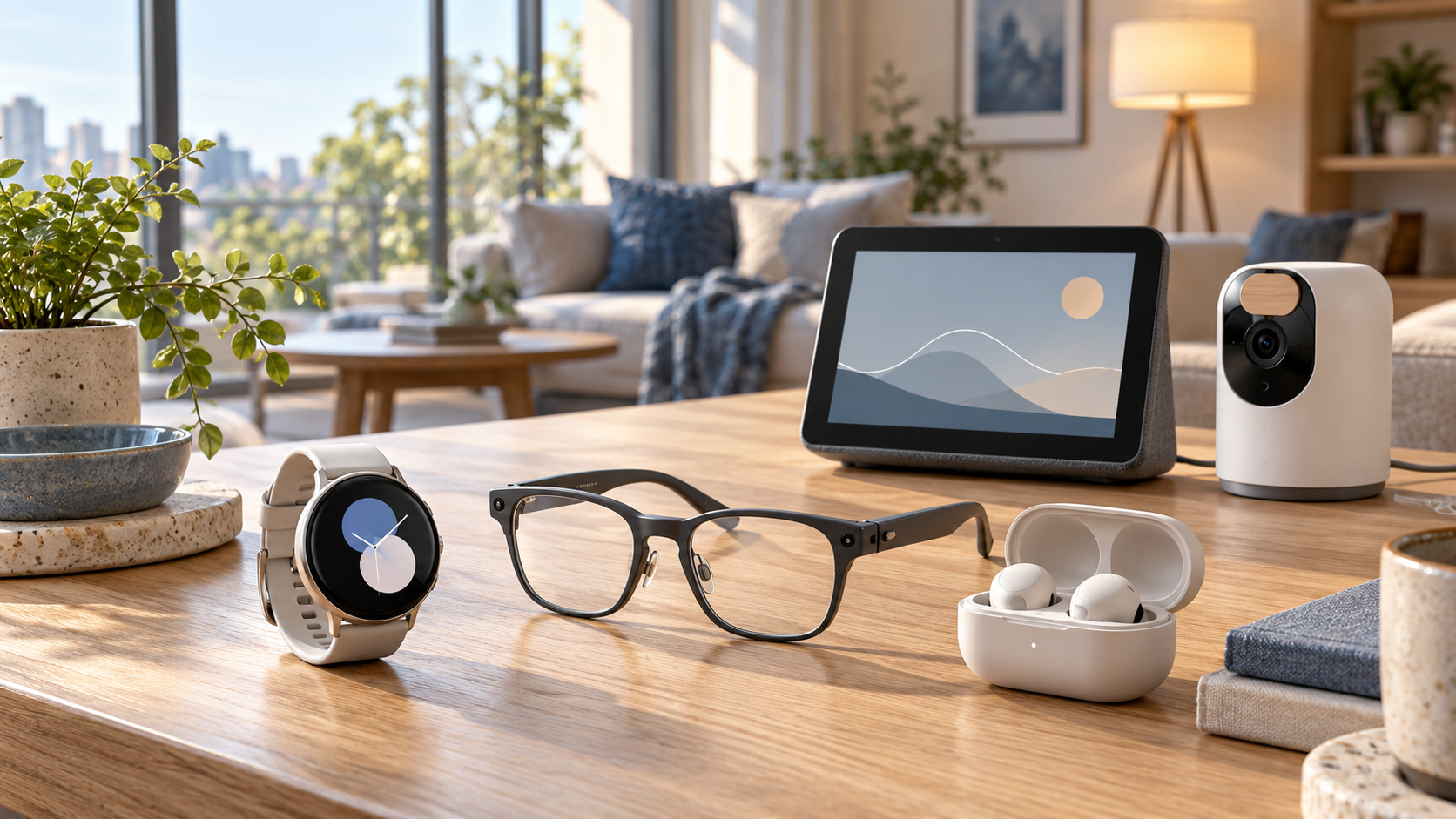
A smart light that takes several taps to switch on creates work.
A watch that needs charging during your evening walk interrupts it.
These small frustrations deserve as much attention as the features
on the box.
Smart hardware combines physical devices with sensors, software,
and connectivity. Some products also use AI to interpret what they
detect. The category includes home cameras, connected appliances,
wearable devices, and more.
Recent developments point toward devices that can process more
information locally and work across different systems. For buyers,
the useful question is how those changes will affect an ordinary day.
More AI Processing Will Happen on the Device
An AI feature can run on the device, on a remote server, or across
both. The difference affects response time, internet dependence,
and where personal data goes.
Qualcomm’s AI Home Hub design illustrates this approach. Its
solution brief
describes local processing for sensitive tasks, including facial
recognition, alongside cloud models for conversation. This is a
platform design, rather than proof that every smart home product
already offers these features.
Consider a home camera. If it can recognize a person locally,
it may avoid sending footage to a server for that particular task.
Remote viewing or other features may still need an internet connection.
Local AI also has limits. Processing power, memory, heat, and
battery capacity restrict what a small device can handle.
Manufacturers have to decide which tasks belong on the device
and which need outside computing.
When comparing products, check which advertised AI features work
offline. “AI-powered” alone tells you very little about how the
product operates.
Devices From Different Brands Should Become Easier to Connect
Adding a device to a home gets complicated when each purchase
needs a separate app or hub. Shared standards give manufacturers
a way to reduce that friction.
Matter is one example. The Connectivity Standards Alliance
released Matter 1.5 in November 2025
.
It added support for cameras, closures such as garage doors,
soil sensors, and further energy management capabilities.
That expansion creates opportunities for more categories of devices
to communicate through a common standard. It does not mean every
existing camera or home platform supports every new feature.
A product’s compatibility still needs checking. Look at the exact
model, its supported functions, and the requirements of your home
platform. A feature available in the manufacturer’s app may work
differently elsewhere.
For someone building a connected home over several years,
compatibility deserves attention before the second or third purchase.
Replacing working equipment to accommodate one new device can
become expensive.
Energy Features Will Become More Useful When Devices Can Act on the Data
An energy dashboard can show how much electricity a device used.
Acting on that information takes additional controls.
Matter 1.5 includes ways to exchange information about electricity
pricing, tariffs, and grid carbon intensity. Compatible devices
can use this information to estimate costs or adjust operation
according to preferences and schedules.
For example, a supported appliance could schedule a flexible task
for a lower-price period. That depends on the appliance, the
control system, and access to suitable tariff data. The standard
provides a technical foundation; the finished product determines
what the household can do.
Buyers should check whether an energy feature measures consumption,
estimates costs, or controls operation. Those are different functions.
Any promised savings also depend on local electricity prices and
how the household uses the equipment.
Wearable AI Has to Fit Into Something Comfortable
AI development extends beyond phones and home hubs.
Qualcomm’s wearable platforms
include support for local AI processing, low-power sensing,
and image processing for devices such as glasses and audio wearables.
These capabilities give manufacturers more options. A wearable
might accept a spoken request or interpret information from a
camera, depending on its design and software.
The physical constraints remain. Glasses sit on your face for hours.
Earbuds have limited space for batteries. Extra processing can
affect heat, weight, and time between charges.
For buyers, a short demonstration leaves several questions
unanswered. Check comfort over a full day, battery life with the
AI features enabled, and whether the device needs a nearby phone.
Also check how microphones and cameras can be disabled.
Software Support Belongs in the Buying Decision
Connected hardware continues to depend on software after purchase.
Apps, accounts, firmware updates, and paid services can all affect
its useful life.
Matter includes support for over-the-air updates, although
manufacturers can also use their own update methods.
The Alliance’s
Matter FAQ
also makes clear that privacy depends partly on the protections
provided by device makers and service providers.
Before buying, look for a stated support period and a clear
explanation of recurring costs. Find out what remains available
if you cancel a subscription or lose internet access.
A useful final check is to name one task you want the device to
handle. Then verify the full process: setup, daily use, charging
or maintenance, and access to support. If a product page leaves
those basics unclear, ask before placing the order.